





In today’s distraction-filled world, staying productive is not just about working harder—it’s about working smarter and with focus. However, many professionals struggle with constant interruptions, multitasking, and unstructured days. This is where the Scientific Time Blocking Technique comes in. It is a powerful, research-backed method that helps high performers take control of their time, energy, and output.
🚀 What is Time Blocking?
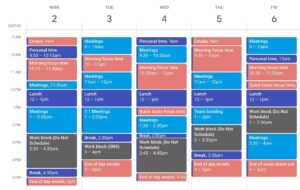
Time blocking is a productivity technique where you divide your day into specific time slots, and each slot is dedicated to a particular task or type of work.
In other words, instead of reacting to tasks as they come, you proactively plan your day in advance.
🔬 Why It’s Called “Scientific”
The technique is rooted in proven psychological and productivity principles:
- Cognitive Focus Theory: Your brain performs best when focused on one task
- Parkinson’s Law: Work expands to fill the time available
- Decision Fatigue Reduction: Fewer decisions = more productivity
- Deep Work Principle: Focused work leads to high-quality output
Therefore, time blocking aligns your schedule with how your brain actually works.
⚙️ How Scientific Time Blocking Technique Works
1. Plan Your Day in Advance
To begin with, identify all key tasks for the day.
Then, assign each task a specific time slot.
👉 Example:
- 9:00 – 11:00 AM → Deep Work
- 11:00 – 12:00 PM → Meetings
- 2:00 – 3:00 PM → Admin Tasks
As a result, your day becomes structured and predictable.
2. Prioritize Deep Work Blocks
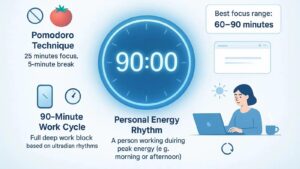
High performers focus on high-value tasks during peak energy hours.
For instance, creative or strategic work should be scheduled when your mind is fresh.
3. Eliminate Multitasking
Instead of juggling multiple tasks, focus on one task per block.
Consequently, your efficiency and quality improve significantly.
4. Add Buffer Time
Unexpected tasks are inevitable.
Therefore, include buffer slots between blocks to handle interruptions.
5. Track & Optimize
Finally, review your day:
- What worked?
- Where did time slip?
- Which tasks took longer?
In conclusion, continuous improvement is key to mastering this technique.
🧠 Benefits of Time Blocking for High Performers
✅ Increased Focus
By dedicating time to one task, distractions are minimized.
✅ Higher Productivity
You complete more work in less time.
✅ Better Time Control
You decide your schedule instead of reacting to it.
✅ Reduced Stress
Clear planning reduces mental overload.
✅ Improved Work Quality
Deep focus leads to better results.
🏆 Time Blocking vs Traditional To-Do Lists
| To-Do List | Time Blocking |
|---|---|
| Tasks without time | Tasks with fixed schedule |
| Easy to delay | Time-bound execution |
| Reactive approach | Proactive planning |
| Lower accountability | Higher discipline |
⚠️ Common Mistakes to Avoid
❌ Overloading Your Schedule
Packing too many tasks leads to burnout.
❌ Ignoring Breaks
Without breaks, productivity drops.
❌ Being Too Rigid
Flexibility is important.
❌ Not Tracking Progress
Without review, improvement is limited.
🔮 Advanced Tips for High Performers
- Batch Similar Tasks (emails, calls, admin work)
- Use Digital Tools (Google Calendar, Notion)
- Follow Energy-Based Scheduling
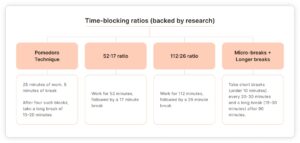
- Apply 90-Minute Deep Work Cycles
-
Scientific Time Blocking Technique for High Performers
🏁 Sample High Performer Daily Schedule
- 6:00 – 7:00 AM → Exercise & Planning
- 7:00 – 9:00 AM → Deep Work
- 9:00 – 11:00 AM → High Priority Tasks
- 11:00 – 1:00 PM → Meetings
- 2:00 – 4:00 PM → Execution Work
- 4:00 – 5:00 PM → Review & Planning
💡 Final Thoughts
In conclusion, the Scientific Time Blocking Technique is a game-changer for high performers. By structuring your day based on focus, energy, and priorities, you can achieve more in less time—without burnout.
Ultimately, success is not about doing more tasks, but about doing the right tasks at the right time.